
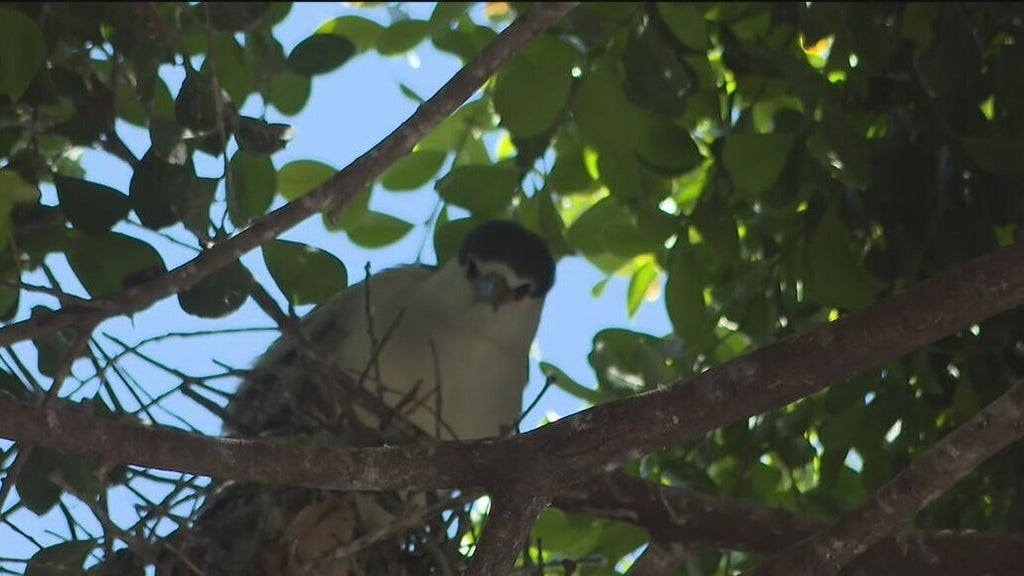
In downtown Oakland at the corner of 12th and Harrison streets, four large Indian laurel ficus trees surround a vacant lot.
High in the canopies every spring and summer during breeding season, you'll spot black-crowned night herons, alongside snowy egrets. For years the dense trees have hosted nearly a hundred nests. The massive urban bird colony or rookery is the largest in the city.
The black-crowned night heron is the official bird of Oakland, thanks to the 3rd graders at Park Day School, who in 2017 launched an initiative to protect the birds, describing the heron as "a cool and funky bird, just like Oakland."
"They thought the black-crowned night heron represented Oakland really well because of how resilient it is," Ryan Nakano of the Golden Gate Bird Alliance said.
Nakano hopes that this funky, cool bird will become more resilient than ever. On the lot, there's a plan to develop 64 units of affordable housing, which is bound to have an impact on the birds' leafy habitat.
"I believe that the plan is to remove these four trees," said Nakano.
There are several reasons to take them down. The ficus trees with their aggressive root systems are known to cause extensive damage to sidewalks and property. As they mature, the higher the likelihood that branches will break off and fall on property beneath them or in the case of birds' nests, allowing for injury or the death of the tiny creatures.
In addition, the night herons and egrets are quite noisy
"They're very loud, and like folks who live down here know," Nakano said. "And they've very messy."
These birds drop a lot of poop which coats sidewalks, parked cars, and pedestrians in a chalky white and very stinky splatter. But what's worse than the squawk and smell are the injured birds. Each year, a number of chicks and fledglings are pushed or fall out of their nests, onto the hard concrete, which causes traumatic and at times fatal injuries.
The International Bird Rescue Center in Fairfield has a dedicated intensive care unit to treat these injured birds.
"This is where they get critical care just like in a hospital," the center's CEO JD Bergeron said.
The Oakland Zoo has a heron rescue team that patrols the downtown streets to rescue fallen or injured birds. Many of the injured end up at the International Bird Rescue.
"You will see some of the smallest snowy egrets and black crowned night herons in care right now," Bergeron remarked.
In the ICU, Bergeron lifted a blanket covering a small, enclosed habitat. Inside, a tiny egret chick who needs an incubator to survive.
"He can't yet regulate his temperature," Bergeron remarked.
As for the urban rookery, Bergeron has seen the damage done to the birds and the danger posed by the environment.
"To be honest i think it's probably a positive thing if those trees eventually come down," he said.
The injuries to the birds can be quite severe, including broken legs, wings, and damaged internal organs. If they are not rescued in time, predators can find them first.
"These birds are perhaps too comfortable in really urban environments which are not super safe for them and also not so great for the people who live nearby," Bergeron said.
The developer for the 12th and Harrison project, East Bay Asian Development Corporation, declined an interview request and referred all requests for information about the project to the City of Oakland.
The city forwarded a report prepared by the ecological consultant group H.T. Harvey & Associates. Biologists with the group were hired to encourage the birds to abandon their rookery at the construction site and establish a new colony near Lake Merritt. The project used decoy birds, transplanted the original nests that were empty to the relocation sites, and played the recorded sounds of mating and breeding to entice the snowy egrets and night herons.
The efforts lasted for two breeding seasons, but ultimately the efforts were unsuccessful.
The next step may be cutting down the trees. Trimming them won't stop the birds from returning. In 2019, a mature ficus tree holding multiple heron nests split in half and partially fell to the ground, sending dozens of newborn chicks to the ground. The tiny birds were rescued and brought to the International Bird Rescue Center.
The birds may have survived, but the incident underscores a major concern at a time when the need for low-income housing in Oakland is critical and growing. The waitlists for the affordable care housing projects are long.
The birds are also an important piece of regional biodiversity puzzle.
"They are very resilient and they do kind of symbolize a lot of the folks who live here in Oakland who similarly face a lot of displacement right? This issue is connected to affordable housing," said Nakano.
The hope is to find safe spaces for both people and the birds.


