
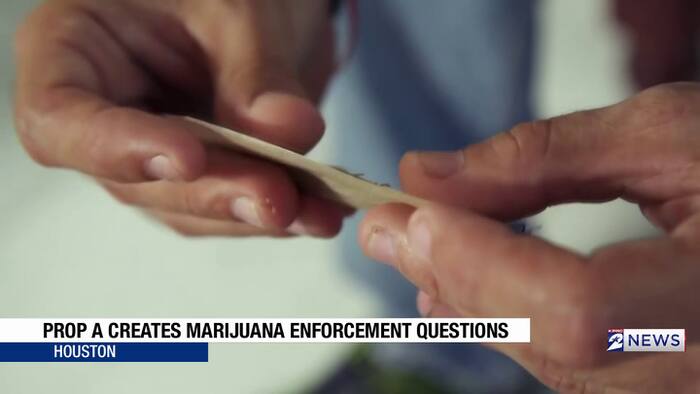
Houston voters approved Proposition A, directing the Houston Police Department to make enforcement of certain low-level marijuana possession offenses its lowest enforcement priority.
But HPD isn’t the only law enforcement agency making traffic stops and responding to calls in Houston.
Harris County constables and sheriff’s deputies also operate within the city. And because Proposition A specifically directs HPD to change its enforcement priorities, those other agencies are not automatically required to follow the same policy.
That could create confusion for residents who assume the new rules apply across the Houston area.
The measure amends the Houston City Charter to require HPD to make enforcement of Class A and Class B misdemeanor marijuana possession its lowest possible enforcement priority.
The proposition also requires the city to update HPD policies and procedures and provide officers with training on the changes.
But it does not legalize marijuana.
Possession remains illegal under Texas law, and the measure preserves law enforcement and prosecutorial discretion to enforce state law.
Criminal defense attorney Corey Roth says the agency someone encounters could make a difference in how a marijuana possession case is handled.
Roth says Proposition A applies specifically to HPD, not other law enforcement agencies operating in the Houston area.
“If it’s HPD, they’re going to handle it one way. If it is the sheriff’s office, they are going to probably handle it a different way because this proposition does not apply to any police department other than the city of Houston,” Roth said.
That distinction matters because multiple law enforcement agencies operate within Houston and Harris County, even when their patrol areas overlap.
Even within the department directly affected by Proposition A, questions remain about what the new enforcement priorities will look like in practice.
Ray Hunt, executive director of the Houston Police Officers’ Union, says officers were not involved in drafting the measure and have not received clear instructions on how to apply it.
“We’ve got no direction from the district attorney’s office, I’m not sure they’re completely sure what it means... we don’t even know,” Hunt said.
Hunt says officers will continue contacting the Harris County District Attorney’s Office when they encounter marijuana possession cases to determine whether charges should be filed or someone qualifies for diversion.
He says officers need clear direction from prosecutors before changing how they handle those encounters.
The Harris County District Attorney’s Office tells KPRC 2 its position has not changed and it has not issued any additional guidance following the passage of Proposition A.
The office says District Attorney Sean Teare has expanded eligibility for the county’s marijuana diversion program.
According to the DA’s Office, just 0.021% of the misdemeanor charges it currently accepts are for marijuana possession.
The office says its approach allows prosecutors to focus limited resources on violent offenders, drug traffickers and organized crime rather than first-time, nonviolent drug offenders.
The DA’s Office also continues to urge the Texas Legislature to clarify cannabis laws during the next legislative session, saying confusion over state marijuana laws affects both law enforcement and residents.
The city still needs to update HPD’s policies and provide officers with training explaining how to carry out Proposition A.
The measure also requires the city to report marijuana enforcement activity and provide information about how the new policy is being implemented.
KPRC 2 reached out to Harris County constables and the Sheriff’s Office to ask whether their marijuana enforcement policies will change following the vote.
Their responses will be added as they become available.
For now, Proposition A changes HPD’s enforcement priorities, but it does not make marijuana legal in Texas or automatically change how other law enforcement agencies handle marijuana possession cases.


